Not Another Meme 🤦🏻♀️
When Cynicism Costs More Than Weekends
The Constructive Rant
When Cynicism Costs More Than Weekends
Observe a job site late on a Friday afternoon and you’ll see it. Crews scrambling to fix the rework no one budgeted for. Superintendents burning phone minutes trying to each the back office who’ve already logged off. And trades pulling weekend overtime just to make sure Monday doesn’t start in chaos.
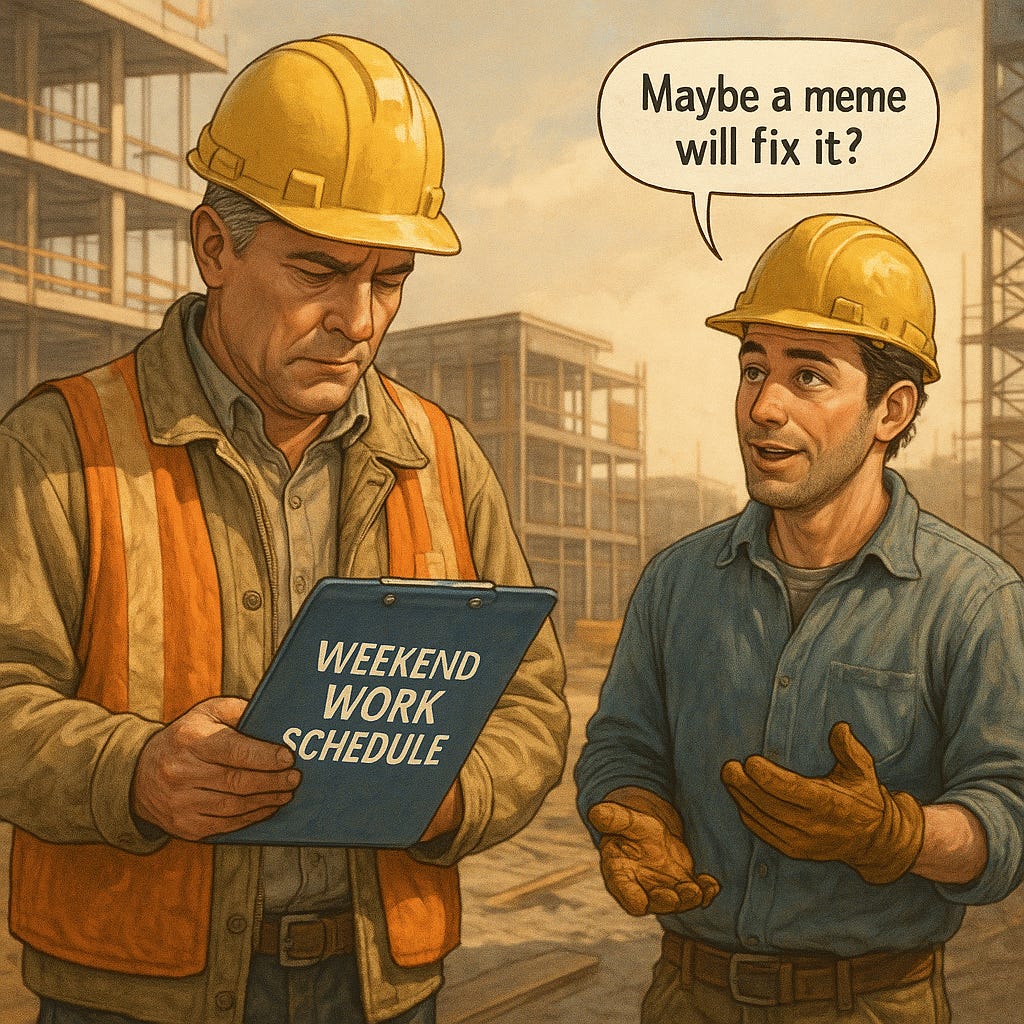
It’s easy for the field to get cynical. Memes online mocking the “disconnect” between the office and job sites circulate faster than RFI responses, racking up mob likes endlessly. They get likes, they get laugh emojis, but they also reinforce a kind of resignation. As if chaos is baked into the system, and the only thing to do is shrug, and continue pointing fingers.
That cynicism is a tax. It blinds us to the real opportunities which are some of the legit fixes already sitting in front of us. And we wonder why trust is gone, why margins collapse, and why younger talent doesn’t want to stick around in an industry that treats dysfunction like an inside joke.
The Constructive Rant
When Cynicism Costs More Than Weekends
Observe a job site late on a Friday afternoon and you’ll see it. Crews scrambling to fix the rework no one budgeted for. Superintendents burning phone minutes trying to reach the back office who’ve already logged off. And trades pulling weekend overtime just to make sure Monday doesn’t start in chaos.
It’s easy for the field to get cynical. Memes online mocking the “disconnect” between the office and job sites circulate faster than RFI responses, racking up mob likes endlessly. They get likes, they get laugh emojis, but they also reinforce a kind of resignation. As if chaos is baked into the system, and the only thing to do is shrug, and continue pointing fingers.
That cynicism is a tax. It blinds us to the real opportunities which are some of the legit fixes already sitting in front of us. And we wonder why trust is gone, why margins collapse, and why younger talent doesn’t want to stick around in an industry that treats dysfunction like an inside joke.
Opportunities Missed, Opportunities Waiting
At Cameo Kitchens & Custom Cabinetry , Vito Luca and his team aren’t just building cabinetry, they’re orchestrating a kind of spatial intelligence. Complex layouts, custom millwork, clever storage solutions. Sleek and on design point. All seamlessly integrated to serve the modern client’s vision. That kind of craftsmanship requires constant verification, not callbacks.
Here’s where apps like Pixly line up naturally:
Kitchen & bath builders can tag installs and document progress without endless photo threads.
Renovators can hand off clean visual proof to clients or inspectors.
Small contractors can share progress shots with out-of-town owners without ten site visits.
Just as a laser level replaced the string line, Pixly replaces the shoebox of unlabeled photos with proof tied to context. It doesn’t turn Cameo’s crew into superheroes, nope. But it simply clears the noise so their work shows through, and their reputations increase.
At Mynott Construction, Michael Mynott wears the hats of General Contractor, Construction Manager, and Project Manager depending on the day. His team balances execution with early-stage advising. You know, weighing budgets, constructibility, and stakeholder coordination before the first shovel hits the ground. That’s exactly where solutions like Ressio Software prove their value:
Centralized schedules keep GCs, subs, and designers aligned without fifteen different versions floating around.
Real-time accountability reduces the classic “who dropped the ball” blame game.
Coordinated workflows prevent the layering of complexity onto already stretched project teams.
The real opportunity for contractors like Mynott, isn’t to put more weight on their technology stacks. It’s to overcome increased project complexity with solutions built for modern coordination. Software solutions like Ressio translate contractor advisory roles into action without drowning in disconnected spreadsheets.
Let's look at Plan Group, where George Toth plays a role in delivering the electrical and mechanical backbone for hospitals, airports, and mission-critical facilities, the margin for error is razor thin. When your projects power smart hospitals or safeguard financial trading floors, even a single miscut pipe spool can mean lost weekends, ballooning costs, and repetitional risk that no contractor can afford.
George’s work represents the frontline of precision in complex builds where this work demands tools that are designed to keep pace with detailed mechanical pipe configurations. Digital connectors like PypeServer let you cut parts directly from your BIM or CAD models. Rather than relying on manual checks and overnight rework, PypeServer connects design models directly to fabrication shop floor machines, producing cut-to-label parts that carry QR codes into the field.
Spools flow from Revit to Cloud+ to fab shop without losing fidelity.
QR-coded labels keep the field and shop synced in real time.
Crews reclaim weekends because errors and rework are reduced before they happen.
The Constructive Closer
Digital tools aren’t magic wands. They don't swoop in to erase bad design or poor planning. These tools have their place no different than a crane, skid steer, or your favourite cordless hammer drill. Each one is the right tool for the right situation solving the disconnects that cynicism loves to exaggerate.
The real choice isn’t between laughing at the problem or pretending it doesn’t exist. It’s between staying stuck in a loop or otherwise reaching for the tools that help any construction pro who wants to see the "big picture" clearly, coordinate accordingly, and reclaim their weekends. I don't happen to believe this is naive optimism.

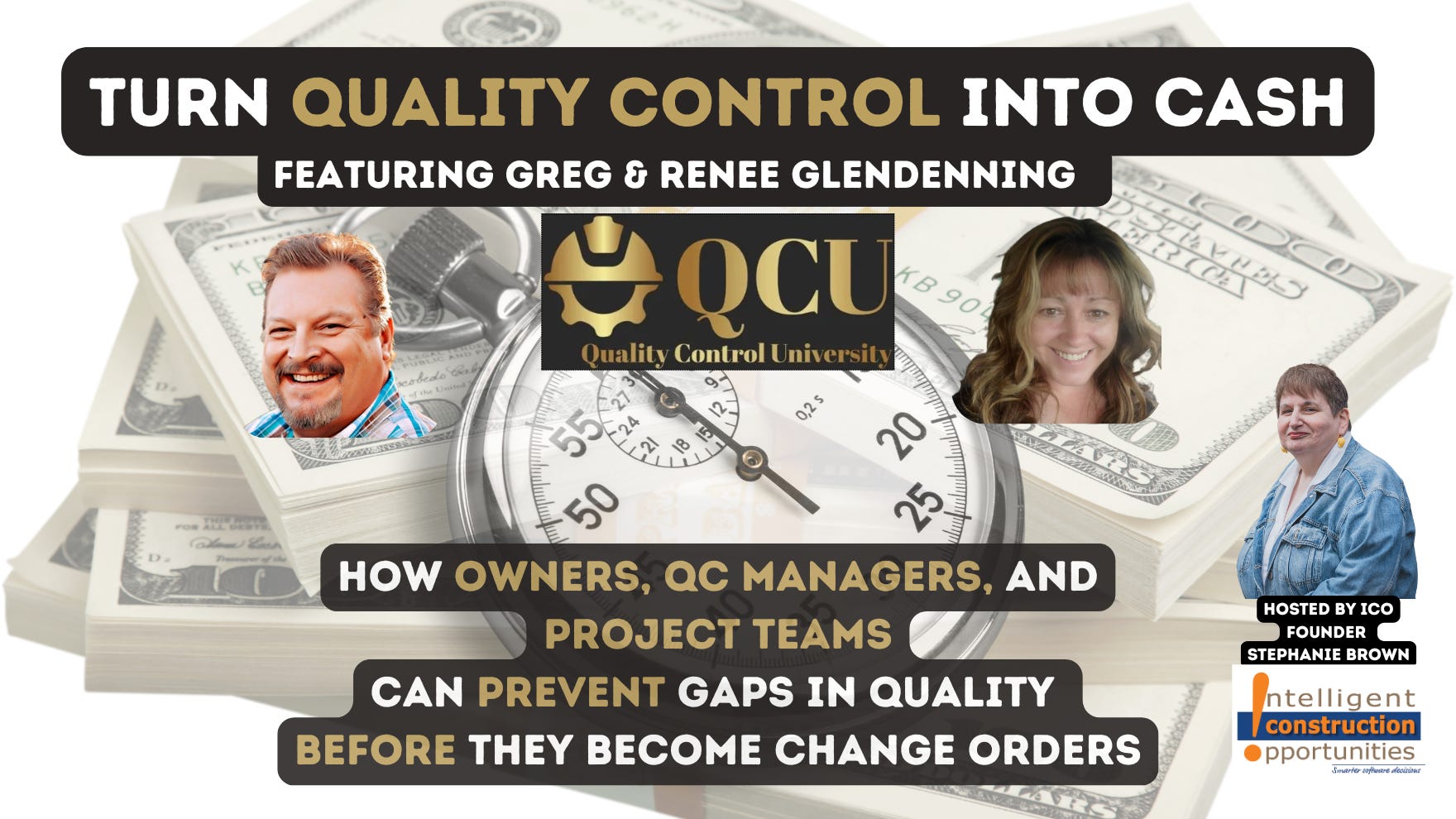
If you work in quality control, project management, commissioning, or carry the weight of the final project delivery, don’t miss the replay of Intelligent Construction Opportunities session with Quality Control University’s Greg & Renee Glendenning.
The real stars here are the tools that keep projects on track: the Responsibility Matrix, Submittal Log, and Cx Flow Chart. The replay shows how each one protects time, trust, and reputation.
🎥 Watch the replay first — then check out the tools for yourself: https://qcuniversity.net/shop/
QC Managers: Stop being the scapegoat. The Responsibility Matrix puts accountability in black and white.
Project Managers: Don’t get stuck firefighting. The Submittal Log keeps approvals visible and on schedule.
Owners & Executives: Protect trust and margin. The Cx Flow Chart prevents the final 10% from turning into chaos.
Superintendents: Sequence trades with confidence. The Cx Flow Chart saves days instead of losing them.
Craftspeople & Subs: Protect your reputation. The Submittal Log ensures your work isn’t questioned at turnover.


If you work in quality control, project management, commissioning, or carry the weight of the final project delivery, don’t miss the replay of Intelligent Construction Opportunities session with Quality Control University’s Greg & Renee Glendenning.
The real stars here are the tools that keep projects on track: the Responsibility Matrix, Submittal Log, and Cx Flow Chart. The replay shows how each one protects time, trust, and reputation.
🎥 Watch the replay first — then check out the tools for yourself: https://qcuniversity.net/shop/
QC Managers: Stop being the scapegoat. The Responsibility Matrix puts accountability in black and white.
Project Managers: Don’t get stuck firefighting. The Submittal Log keeps approvals visible and on schedule.
Owners & Executives: Protect trust and margin. The Cx Flow Chart prevents the final 10% from turning into chaos.
Superintendents: Sequence trades with confidence. The Cx Flow Chart saves days instead of losing them.
Craftspeople & Subs: Protect your reputation. The Submittal Log ensures your work isn’t questioned at turnover.
Future Crew
Role Overview The Construction Data Analyst translates jobsite chaos into actionable insights. They review raw logs, costs, schedules, safety reports, and submittals, turning noise into constructive action for PMs, supers, and executives.
Core Responsibilities
Aggregate data from field tools, scheduling apps, and financial systems.
Build dashboards and visualizations that highlight risks, trends, or bottlenecks.
Communicate findings in plain language for leadership and project teams.
Essential Training / Experience
Strong background in data visualization (Power BI, Tableau).
Familiarity with BIM models and construction workflows.
Ability to bridge technical data with practical project realities.
Some Technologies Already Emerging
Kroo → workforce and safety insights.
Procore Analytics → integrated dashboards tied to project data.
Power BI / Tableau → flexible analytics across multiple platforms.
Role Pivot (Where Talent Might Come From)
Current Roles Likely to Pivot: Project Engineers, BIM Coordinators, Estimators, or Field Engineers who already work closely with digital tools and reporting.
Transferable Skills: Strong Excel and scheduling experience, comfort with cloud-based platforms (Procore, Autodesk), and field/office communication skills.
Education / Training Recommendations: Short-term data analytics certifications, applied courses in construction technology management, or specialized bootcamps in visualization tools (Power BI, Tableau).
Why It Matters As projects generate more data than teams can absorb, this role becomes more and more critical. This role ensures Owners, Owner Reps, GCs, and Subs alike can avoid costly blind spots, strengthen decision-making, and anticipate problems before they escalate.